

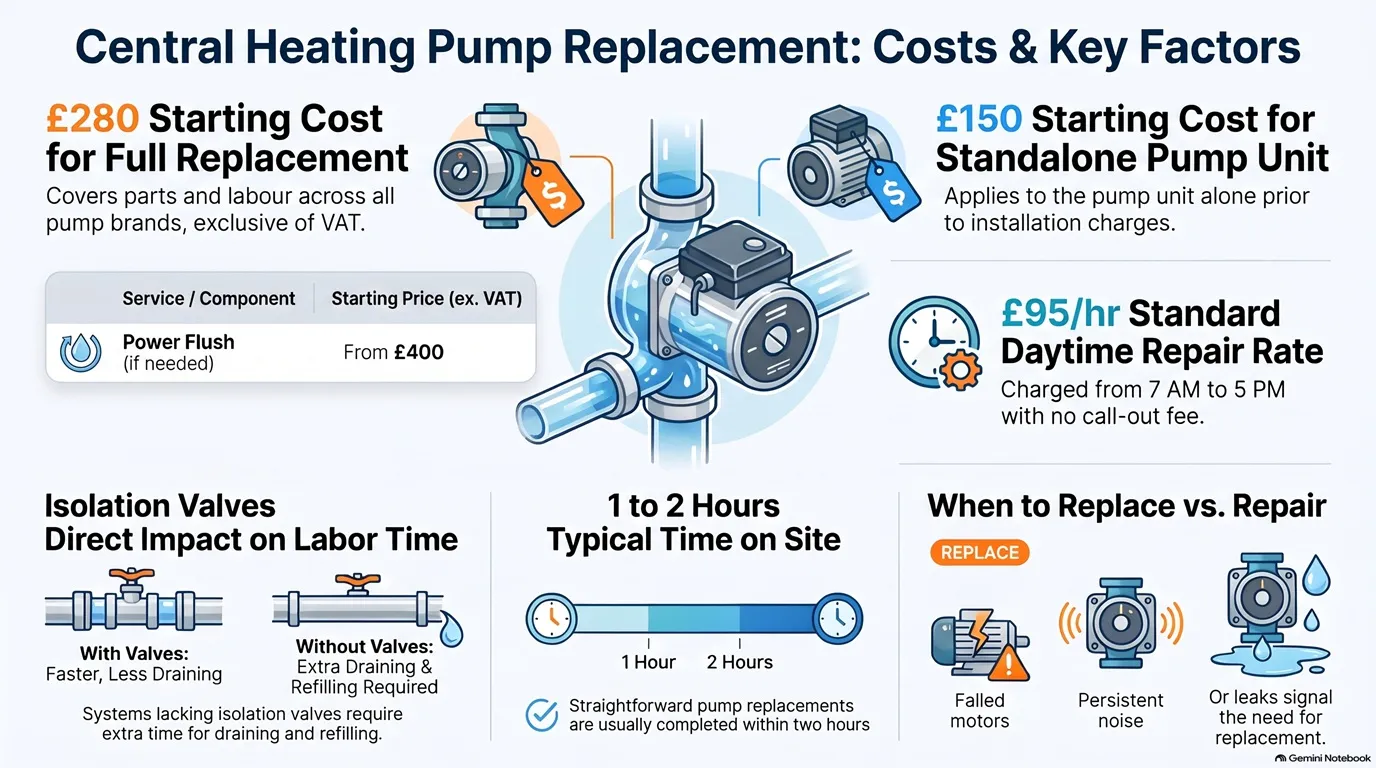
Central heating pump replacement with BeFix starts from £150 for the pump unit and from £280 for a full replacement, parts and labour, both exclusive of VAT. The same starting prices apply across all pump brands.
| Aspect | Details |
|---|---|
| Pump Unit Only | From £150, exclusive of VAT |
| Full Replacement (Parts and Labour) | From £280, exclusive of VAT |
| Brands | Same starting prices across all pump brands |
| Repair Labour Rates | £95, £125 or £160 per hour depending on the time of day, exclusive of VAT, with no call-out fee |
| Main Price Factors | System layout, access to the pump, isolation valves, any extra work found on the day |
| Time on Site | Usually one to two hours for a straightforward replacement |
| No Isolation Valves | Draining and refilling takes extra time and is charged on top of the starting prices |
| Power Flush (if needed) | From £400, depending on the number of radiators |
| Workmanship Warranty | 12 months from BeFix |
A central heating pump moves hot water from your boiler round the radiators. When it fails, the boiler may fire but the heat doesn’t reach the rooms. This guide sets out what a pump replacement costs with BeFix in London, what pushes the price up, and how to tell whether your pump needs replacing or just a repair. If you want to hear it from an engineer, call BeFix on 020 8058 4241.
What Is a Central Heating Pump?
A central heating pump (also called a circulator pump or boiler pump) is an electrically powered device that pushes hot water from your boiler through the pipes to your radiators and back again. Without a working pump, the water stays where it is and the radiators stay cold.
In a combi boiler the pump sits inside the boiler. Many system boilers also have the pump built in, while in regular (heat-only) systems and some older or more complex installations it’s usually a separate unit, often near the hot water cylinder or in an airing cupboard. It runs whenever the heating is on, so it has a hard life, and a noisy or sluggish one is often the first sign of trouble. If yours is making a racket, our guide to a noisy central heating pump explains the likely causes.
Signs Your Central Heating Pump Needs Replacement
- Humming, grinding or vibrating noises
- Radiators heating unevenly or not at all
- Water leaking from the pump
- A working boiler but no hot water reaching the radiators
- The pump doesn’t start when the heating comes on
- The pump runs constantly and won’t switch off
- Higher than normal energy bills
- Unusual heat from the pump together with noise, tripping or poor circulation
- Visible corrosion or damage
- An older pump with persistent noise, reduced circulation or repeated faults
Radiators that stay cold can also point to a stuck valve or a blocked system rather than the pump, so it’s worth having an engineer confirm the fault before you buy anything. Our page on a central heating pump covers how the pump fits into the wider system.
Central Heating Pump Replacement Cost Breakdown
With BeFix, a pump unit starts from £150 and a full replacement, with parts and labour, starts from £280. Both prices are exclusive of VAT and apply whichever brand of pump you choose.
The final figure depends on the points below, which is why BeFix confirms the price once an engineer has seen the pump and the pipework in person.
How Much Does Boiler Pump Replacement Cost?
The starting prices above are what you pay before any extra work. The final bill depends on how easy the pump is to reach, whether the system can be isolated without draining it, and whether the engineer finds anything else that needs fixing while the pump is out.
For repair visits and diagnosis, BeFix labour is charged at £95 per hour from 7AM to 5PM, £125 per hour from 5PM to 9PM and £160 per hour from 9PM to 7AM, all exclusive of VAT. There is no call-out fee.
Does Combi Boiler Pump Replacement Cost More?
It can. A separate pump sitting on the pipework is usually quick to reach and swap. A pump built into a combi boiler may need a part made for that specific boiler, and getting to it can take more work. BeFix quotes this kind of job once the engineer has seen the boiler model and how it’s installed.
Factors Affecting Central Heating Pump Replacement Cost
A few things decide where your final price lands:
1. Pump Type
Pumps come in a few types. BeFix’s starting prices are the same whichever you choose, but the type affects how the pump behaves and how much electricity it uses. If you want to check that a pump suits your system, read about central heating pump sizing:
| Pump Type | Features |
|---|---|
| Standard Fixed Speed | Basic operation, speed set by hand |
| Energy Efficient Variable Speed | Adjusts its speed automatically, uses less electricity |
| Smart or Connected Pumps | System monitoring and smartphone settings |
2. System Layout
The layout of your heating system can change the amount of work involved:
- Isolation valves: If the pump has isolation valves either side, the engineer can swap it without draining the whole system. Without them, more of the system may need draining and refilling. The starting prices assume the pump can be isolated with valves, which most systems have. If there are no isolation valves, draining and refilling takes extra time and is charged on top.
- Access: A pump in a cramped airing cupboard or under floorboards takes longer to reach and replace.
- Sludge or debris: If the water is dirty, the system may need cleaning before a new pump goes in. BeFix also carries out power flushing, which starts from £400 and depends on the number of radiators.
- Pipe fittings: Older systems sometimes need fittings adjusted to suit a modern pump.
3. Time of Day
BeFix doesn’t charge a call-out fee, so the difference between a scheduled visit and an urgent one comes down to the hourly rate for that time of day:
Daytime Visit
- £95 per hour from 7AM to 5PM
- Exclusive of VAT
- No call-out fee
- Time to choose the right pump
Evening or Night Visit
- £125 per hour from 5PM to 9PM
- £160 per hour from 9PM to 7AM
- Exclusive of VAT
- No call-out fee
4. Additional Work Required
Replacing a pump sometimes shows up other problems:
- Worn valves or fittings that need replacing
- Old pipework that no longer suits the new pump
- Radiators that need balancing afterwards
- Missing isolation valves that are worth adding
BeFix will explain any additional work and provide a quote before proceeding.
Repair vs. Replace: Making the Right Decision
Not every pump problem means a new pump. If you are still working out what is wrong, our guide to a central heating pump not working covers the common causes. A stuck impeller or trapped air can often be sorted with a repair, while a worn-out motor can’t:
When Repair Makes Sense
- The pump is fairly new
- The problem is minor, such as a stuck impeller or trapped air
- The repair costs well under the price of a replacement
- The pump is a premium model worth keeping
When Replacement Makes Sense
- The pump is old and showing wear, such as noise or reduced flow
- The motor has failed or the pump is leaking
- You’ve had several repairs already
- The pump is inefficient and your energy bills are high
If you’re not sure which applies, see our guide to boiler repair in London or call BeFix and describe the symptoms.
Energy Efficiency Considerations
A modern variable speed pump uses far less electricity than an older fixed speed one, because it slows down when the system doesn’t need full flow (our guide to central heating pump speed explains how the settings work). If your current pump is old and runs flat out all day, the saving on your electricity bill is a real reason to upgrade rather than repair.
Common Central Heating Pumps
These are three pumps you’ll often come across in UK homes. BeFix’s starting prices are the same whichever one you choose:
Grundfos UPS3 15-50/65
Energy Efficient
- Selectable speed settings
- Low energy consumption
- A common like for like swap
Grundfos ALPHA3
Variable Speed
- Adjusts its speed automatically
- Bluetooth connection for settings
- Suited to systems that change demand through the day
Wilo Yonos PICO
Variable Speed
- LED display
- Straightforward to fit
- Low energy consumption
The Installation Process
Here’s what happens during a replacement, which also explains why the price varies from one home to the next:
- System preparation: The heating is switched off and the pump is isolated with valves, or the system is drained if there are no valves.
- Electrical disconnection: The power to the old pump is safely disconnected.
- Removal of the old pump: The pump is disconnected from the pipework and taken out.
- Preparing the connections: The pipe connections are cleaned and new washers or seals are fitted.
- Fitting the new pump: The new pump goes in with the flow direction checked.
- Electrical reconnection: The pump is wired back to the power supply.
- Refilling: If the system was drained, it’s refilled.
- Air removal: Air is bled from the pump and the system.
- Testing: The pump is run to check it’s working properly.
- Balancing: Radiators are balanced if needed so the heat spreads evenly.
A straightforward pump replacement usually takes one to two hours. Draining and refilling adds to the job and is charged extra, and any complications found along the way can add more, which is why the final price is confirmed once the engineer has seen the system.
Hiring a Professional vs. DIY
Some confident DIYers consider swapping a pump themselves. Before you do, weigh up the following:
Professional Installation Benefits
- Gas Safe registered engineers, BeFix is Gas Safe 967796
- Safe electrical connections
- Manufacturer warranties often expect a professional installation
- The system is bled and balanced afterwards
- Other faults can be spotted while the pump is out
- A 12 month workmanship warranty from BeFix
DIY Considerations
- Needs plumbing and electrical knowledge
- Risk of water damage if a joint is wrong
- May affect your boiler warranty
- No workmanship guarantee
- Special tools may be needed
- May affect your home insurance
Important: Never remove a gas boiler’s casing or attempt repairs inside the appliance yourself. Work that involves gas fittings, or that affects the safety of a gas appliance, must be carried out by a Gas Safe registered engineer. Replacing an external circulating pump also takes plumbing and electrical competence. If you smell gas, put out any flames, open doors and windows, avoid switching electrical items on or off, and call the National Gas Emergency Service on 0800 111 999 straight away.
Conclusion: Getting the Best Value
With BeFix, replacing a central heating pump starts from £280 for parts and labour, or from £150 for the pump unit alone, exclusive of VAT, whichever brand you pick. Your final price depends on access, the isolation valves and anything else the engineer finds. A good pump often lasts 10 to 15 years, and a newer variable speed model can cut the electricity it uses.
A few things help you get the best value:
- Ask for the full price, including parts, labour and VAT, before work starts
- Choose a Gas Safe registered engineer
- Replace an old, noisy pump before it fails in mid winter
- Ask what warranty covers the pump and the workmanship
- Keep up annual boiler servicing so small faults get caught early
To get a price for your own home, call BeFix on 020 8058 4241. Lines are open Monday to Friday 7AM to 10PM and Saturday and Sunday 9AM to 8PM.
Frequently Asked Questions
How much does boiler pump replacement cost with BeFix?
A pump unit starts from £150 and a full replacement, with parts and labour, starts from £280, both exclusive of VAT. The same starting prices apply across all pump brands. The final figure depends on your system and access, and BeFix confirms it once an engineer has seen the fault in person.
How long does it take to replace a central heating pump?
A straightforward replacement usually takes one to two hours. If the pump has no isolation valves, draining and refilling the system takes extra time and is charged on top of the starting price.
How long does a central heating pump typically last?
A good pump often lasts 10 to 15 years with regular servicing. Water quality, how hard the pump works and the quality of the installation all affect that. Annual boiler servicing helps catch pump problems before the pump fails completely.
Can I replace just the pump head instead of the entire unit?
Sometimes. Some pumps have a replaceable head, which can be cheaper than a whole new unit, but it only works if the pump body and connections are in good condition. An engineer can tell you whether it suits your system.
Will my home insurance cover central heating pump replacement?
Standard home insurance usually doesn’t cover a pump that has failed through age or wear and tear. Boiler cover or home emergency cover may include it, so check your policy wording.
How can I tell if my pump needs replacing or just needs repair?
A recent noise, a pump that cuts in and out, or a small leak at a connection can often be repaired. A failed motor, a major leak, repeated repairs or heavy corrosion usually points to replacement. Age is only one factor, though an older pump makes replacement more likely. An engineer can confirm which applies.
Leave A Comment