

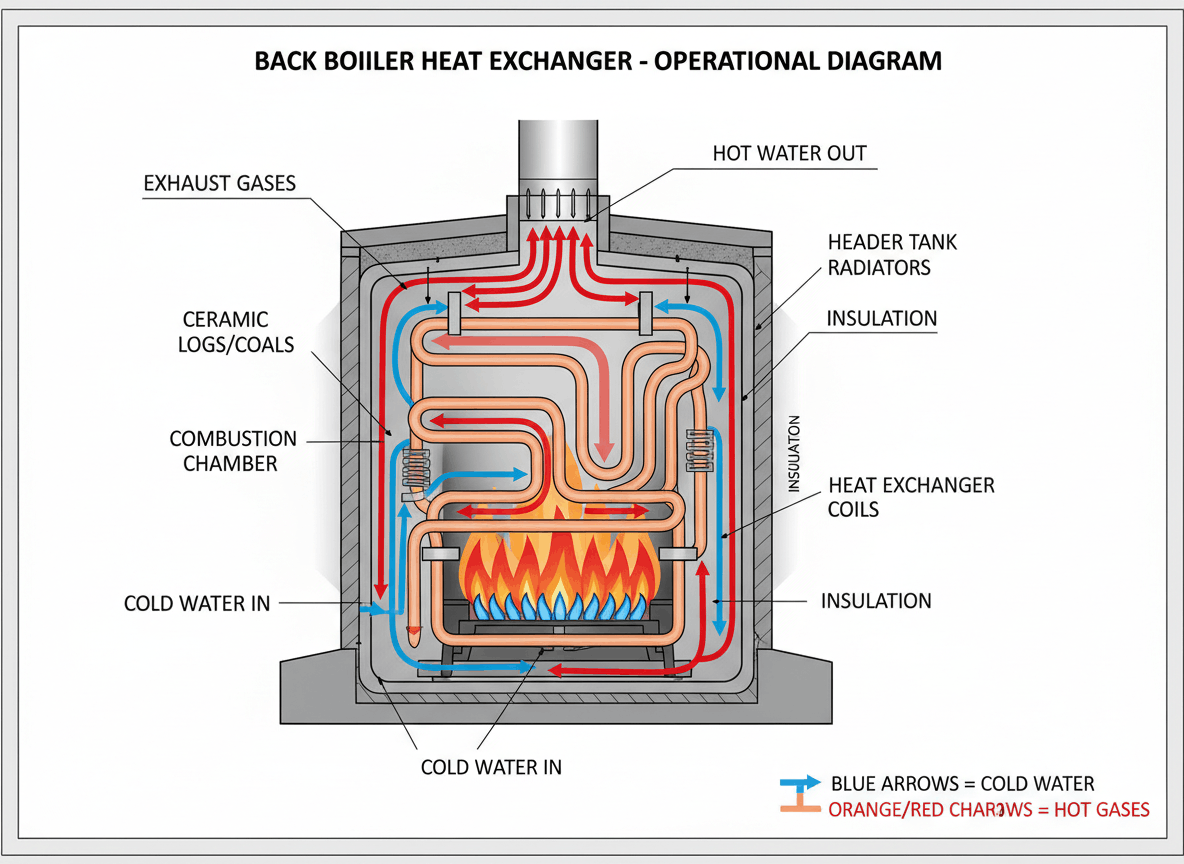
A back boiler sits behind your gas fire or fireplace and does two jobs at once: it heats the room through the visible fire, and it heats water that gets pumped or drawn off to your radiators and hot water cylinder. Older units rely on convection alone to move that water round, newer ones use an electric pump. They haven’t been fitted new since 2005, so if there’s one in your house, it’s at least two decades old and running well below the efficiency of a modern boiler.
| Topic | Key Point |
|---|---|
| What it is | A heating unit built into a fireplace or gas fire, heating both the room and your water |
| How it works | A heat exchanger behind the fire warms water, which circulates to radiators and a storage cylinder |
| Still legal to use? | Yes, existing units can keep running. New installations have been banned since 2005 |
| Homes still using one | A significant number, mostly in 1960s-80s terraced and council-built housing |
| Efficiency | Roughly 55% to 72%, against 90%+ for a modern A-rated boiler |
| Lifespan | Many run for 30 to 40 years, which says more about how simple they are than how well they perform |
| Asbestos risk | Units from before the mid-1980s may contain it in gaskets or seals |
| Replacement cost | From £2,950 with BeFix (+VAT), final figure confirmed on-site |
What Is a Back Boiler?
It’s a compact heating unit tucked into the chimney breast, directly behind a gas fire or, in older properties, a solid fuel fireplace. Rather than standing alone in a kitchen or cupboard like a modern boiler, it’s built into the fireplace itself and uses the existing chimney to vent exhaust gases. Baxi, Glow-worm, Ideal and Valor were the big names fitting these across UK homes, and plenty of their units are still working today, just not particularly well.
How Does a Back Boiler Work?
The mechanics are simple, which is part of why so many have lasted this long. Gas (or in older properties, coal or wood) burns and heats a metal heat exchanger sitting just behind the fire front. Cold water enters that exchanger, picks up heat, and either rises naturally through convection in gravity-fed systems or gets pushed along by an electric pump in the more common pumped versions. From there it splits: some goes to a hot water storage cylinder for your taps and shower, the rest circulates through your radiators. Waste gases vent up through the chimney the same way smoke from an open fire would.
The Complete Water Circuit
- Cold mains water fills the hot water storage cylinder, usually in an airing cupboard
- That water flows down to the back boiler’s heat exchanger
- The gas fire (or solid fuel) heats the exchanger and warms the water inside it
- Heated water rises back to the cylinder through convection, or gets pumped there
- One circuit draws hot water from the cylinder out to your radiators
- A second circuit supplies hot water to your taps and shower
- As you use hot water, cold water replaces it and the cycle keeps going
Types of Back Boiler
Not every back boiler is the same, and the type behind your fireplace affects how it runs and what’s involved in dealing with it.
Gas Fire Back Boiler
The version most UK homes have. A conventional gas fire sits at the front, with the boiler unit built in behind it. These are what got banned from new installation in 2005, and they’re the ones this guide mostly covers.
Solid Fuel or Coal Back Boiler
Older still, and found mainly in period properties that never switched to gas. A coal or wood fire heats the exchanger instead of a gas flame, and the system has to stay open vented, never sealed, because a blocked or boiling unit can build up dangerous steam pressure. The real danger isn’t usually one that’s running properly, it’s one that’s been left in place after a heating upgrade. If a solid fuel back boiler was decommissioned when the house switched to gas or oil but never actually removed, and someone lights a fire in front of it without knowing it’s still sealed behind the panelling, that pressure has nowhere to go. The Health and Safety Executive has issued alerts about exactly this happening. If you’re not sure whether an old fireplace has a redundant back boiler hidden behind it, get it checked before lighting a fire.
Back Boiler vs Modern Combi Boiler
| Factor | Back Boiler | Modern Combi Boiler |
|---|---|---|
| Efficiency | 55% to 72% | 90% or above |
| Hot water supply | Limited to what’s stored in the cylinder | Unlimited, heated on demand |
| Space needed | Fireplace cavity, plus a cylinder and often a loft tank | One compact unit, usually in a kitchen cupboard |
| Smart controls | Basic or none | Compatible with smart thermostats and zoning |
| Spare parts | Increasingly hard to source | Widely available |
| Can you buy one new? | No, banned from new installation since 2005 | Yes |
| Typical lifespan | 30 to 40 years | 10 to 15 years |
| Running costs | Higher, standing losses plus a constant pilot light | Lower, modulates output to what’s actually needed |
| Impact on your EPC rating | Drags it down | Can meaningfully improve it |
| Servicing | Annual service essential, fewer engineers still cover them | Straightforward annual service, any Gas Safe engineer |
Why Were Back Boilers So Popular?
They were everywhere by the late 1970s, fitted as standard in new-build and refurbished homes across the country, and for good reason at the time. Terraced houses and smaller semis didn’t have room to spare for a separate boiler, so building the unit into an unused chimney cavity made sense. Installation was reasonably priced for the time too, since it used chimney infrastructure that was already there, which made it a natural upgrade for the many homes converting from solid fuel fires to gas in that period. You got a visible, cosy fire in the living room and whole-house heating from a single installation. Early models from Baxi and Glow-worm also earned a reputation for just running and running with barely any attention, which is exactly why so many are still going strong decades later.
How Many Homes Still Have a Back Boiler?
A meaningful share of UK homes still rely on a back boiler heating system to keep the place warm. There’s no single reliable, up to date national count, but they’re concentrated in the same kinds of properties that had them fitted originally: terraced housing across Northern England, 1970s council-built estates, and Victorian or Edwardian homes converted to gas decades ago. Replacement costs running into thousands of pounds are the main reason so many are still in place. Some homeowners are also put off by the disruption, especially if new radiators or pipework end up needed alongside the boiler itself, and plenty simply don’t realise how much a modern condensing boiler would actually save them each year. On top of all that, a working back boiler still heats the house, just expensively.
Are Back Boilers Still Efficient?
No, and this is really the whole case for replacing one. A pre-1985 unit typically runs at 55% to 65% efficiency, later models improve slightly to 65% to 72%, and a modern A-rated combi or system boiler sits at 90% or above. That gap shows up directly on your gas bill.
Why They Cost More to Run
A permanent pilot light burns gas around the clock whether you need heat or not. Older heat exchangers lose more heat than they capture. Gravity circulation has to work harder than a pumped system. And a hot water cylinder, even a well-lagged one, loses heat sitting there waiting to be used. Put together, a household running a pre-1990 back boiler is often wasting 30% to 40% of the gas it’s paying for, and switching to a modern condensing boiler typically saves £400 to £700 a year on heating.
Advantages and Disadvantages of Back Boilers
| Advantages | Disadvantages |
|---|---|
| Visible fire as a room feature | Efficiency well below modern boilers |
| Frees up cupboard or kitchen space | Hot water runs out once the cylinder is empty |
| Proven longevity, often 30 to 40 years | Spare parts increasingly hard to find |
| Simple mechanical design, little to go wrong electronically | No smart heating controls or zoning |
| Familiar to older, experienced engineers | Rising running costs as energy prices climb |
Is a Back Boiler Safe?
A back boiler that’s serviced every year and hasn’t been altered is generally safe to keep using. The concerns build up with age and neglect, not from the basic design.
Back Boiler Regulations
Are back boilers still legal? Yes, an existing one is fine to keep running. What changed in 2005 is new back boiler installation: Part L of the Building Regulations started requiring new boilers to meet high-efficiency, condensing standards that a back boiler simply can’t achieve, so you can’t fit a new one, only replace it with a different type of boiler.
Asbestos Risks
Units installed before the mid-1980s may have asbestos in the gaskets, seals or internal insulation, which was standard heat-resistant material at the time. If you’re planning any work on an older back boiler, from a service to a full removal, get it assessed by a professional first. Don’t attempt to disturb the casing or seals yourself.
Carbon Monoxide Safety
Most back boilers are open-flued, meaning they draw combustion air from the room rather than outside, which raises the stakes if seals or ventilation deteriorate with age. Annual servicing by a Gas Safe registered engineer, plus a working carbon monoxide detector in the room, are the two things that keep this genuinely low-risk. Between services, keep an eye out yourself: a yellow or orange flame instead of blue, soot marks around the fire, or a pilot light that keeps going out are all worth getting checked. Never block the ventilation grille around the fire either, it’s there for a reason.
How Long Do Back Boilers Last?
Longer than almost anything else in your heating system, which is part of the problem. Well-maintained units regularly reach 30 to 40 years, some go further, and that durability comes from having so few moving or electronic parts to fail. It doesn’t mean the unit is still doing its job well, just that it hasn’t broken. An annual service (combustion check, heat exchanger inspection, flue check, carbon monoxide test) typically costs £80 to £120 and is worth every penny for as long as you keep the unit running.
Can You Replace a Back Boiler With a Combi Boiler?
For most homes, yes, and it’s the most common upgrade path. A combi heats water on demand, so the cylinder in your airing cupboard and, if you have one, the cold water tank in the loft can both come out, freeing up space as well as cutting your bills.
Combi Boiler
The default choice for smaller to medium homes with one bathroom. No cylinder, no loft tank, and hot water whenever you turn on a tap. BeFix carries out boiler installation London-wide every week, so a back boiler to combi swap is familiar territory.
System Boiler
Keeps a hot water cylinder but drops the cold water tank. Better suited to larger homes or anywhere two bathrooms might need hot water at the same time. It’s often paired with an unvented cylinder, and BeFix’s Megaflo installation London engineers fit these as a routine part of system boiler swaps.
Wood-Burning Boiler Stove
A genuine alternative if you like the idea of a real fire but want to move away from gas. Unlike a standard wood burner, which just radiates heat into the room, a boiler stove has a water jacket built around the firebox, splitting its output between the room and your heating circuit. A 30kW stove, for example, might send around 7kW into the room and the remaining 23kW into the water system, enough for 11 or 12 radiators. It’s properly renewable, but it asks a lot in return: expect to get through a full builder’s bag of logs a week if you’re running it 14 to 15 hours a day, and you’ll need dry, covered storage for that wood. Adding thermal mass, a larger tank or sometimes sand packed behind the burner, can stretch residual heat out to 10 to 12 hours after the fire’s gone out. Installation is also more involved than a standard stove fit, since it needs proper integration with your radiator circuit, and fewer engineers take these jobs on because they’re relatively rare. Worth planning for too: most households still need a small immersion heater or secondary boiler for hot water in summer, when nobody wants the stove lit just to run a shower.
Conventional Boiler
Keeps both the cylinder and the cold water tank. It’s the least common choice for a back boiler swap today, but occasionally the right fit for a larger property with low mains pressure.
What Does Replacing a Back Boiler Cost?
| Job | Price | Time on Site |
|---|---|---|
| Back boiler to combi swap | From £2,950 (+VAT) | 2 to 3 days, longer if asbestos removal is needed |
| Annual service or safety inspection | £80 to £120 | Under a day |
£2,950 is BeFix’s starting price, exclusive of VAT. It covers removing the old unit, taking out the gas fire front, disconnecting the cylinder and any loft tank, fitting the new boiler, and certifying the work. Where asbestos removal, awkward access, or extra pipework pushes the job beyond a straightforward swap, that gets reflected in the final figure, which a BeFix engineer confirms once they’ve seen the job in person. If your household receives certain benefits, it’s also worth checking your eligibility for support through the government’s ECO4 scheme before booking any work.
What to Expect When You Book a BeFix Back Boiler Replacement
The engineer starts by checking whether your unit is likely to contain asbestos based on its age, then assesses the fireplace, flue and existing pipework before recommending combi, system or another option based on your home and hot water needs. If asbestos is a possibility, that gets tested and safely removed by a licensed specialist before any boiler work begins, never handled as an afterthought. Once that’s clear, the swap itself, removing the old unit, fitting the new boiler, and making good the fireplace opening, normally takes two to three days for a standard job. You’ll get Building Regulations certification once it’s done.
Back Boilers and the Value of Your Living Room
Removing a back boiler means removing the gas fire in front of it too, which is usually seen as a downside but doesn’t have to be. It’s a genuine chance to rethink that wall: a decorative electric fire, a wood burner, open shelving, or simply plastering over the opening for a cleaner look. Most homeowners treat it as part of a wider refresh rather than just a heating job. Expect a little cosmetic repair to the chimney breast once the old unit and fire front are out.
FAQs
Is it worth repairing a back boiler, or should I replace it?
If a repair quote comes in above £500 to £600, replacement usually makes more financial sense once you factor in the energy savings. Get a boiler repair in London quote first if you’re not sure which side of that line you’re on. For a unit already over 30 years old, even a smaller repair is often a sign to start planning a replacement instead.
Can I still get parts for an old Baxi or Glow-worm back boiler?
It depends on the model and age. Some basic parts are still available through specialist suppliers, but heat exchangers and control units for 1970s and 1980s models are often no longer made at all, and finding them gets harder every year.
Will removing my back boiler damage my fireplace?
The gas fire front comes out as part of the job, which does change how that wall looks, but a good installer keeps the damage to a minimum. Afterwards you can fit a decorative fire, add shelving, or close the opening completely, whatever suits the room.
Do back boilers work with underfloor heating?
Technically yes, since underfloor heating needs lower water temperatures than radiators, which a back boiler can supply. In practice it’s not worth it. If you’re considering underfloor heating, that investment is better spent on a modern boiler designed to run it efficiently.
How can I make my existing back boiler run a bit more efficiently?
Check your cylinder has a decent insulating jacket, lag the hot water pipes, fit thermostatic radiator valves, and keep up with annual servicing. None of this closes the gap with a modern boiler, but it can trim 10% to 15% off the waste.
Still Wondering About Your Back Boiler?
A back boiler that’s properly serviced isn’t dangerous, it’s just expensive to run and getting harder to keep parts for. Most homeowners end up asking not whether to replace one, but when. If you’d like a straight answer on your options, BeFix’s Gas Safe registered engineers can assess your system and talk you through combi, system or wood-burning stove replacements. Call BeFix on 020 8058 4241 to book a visit.
Reviewed by the BeFix Gas Safe registered engineering team (Gas Safe Registration: 967796).
Leave A Comment