

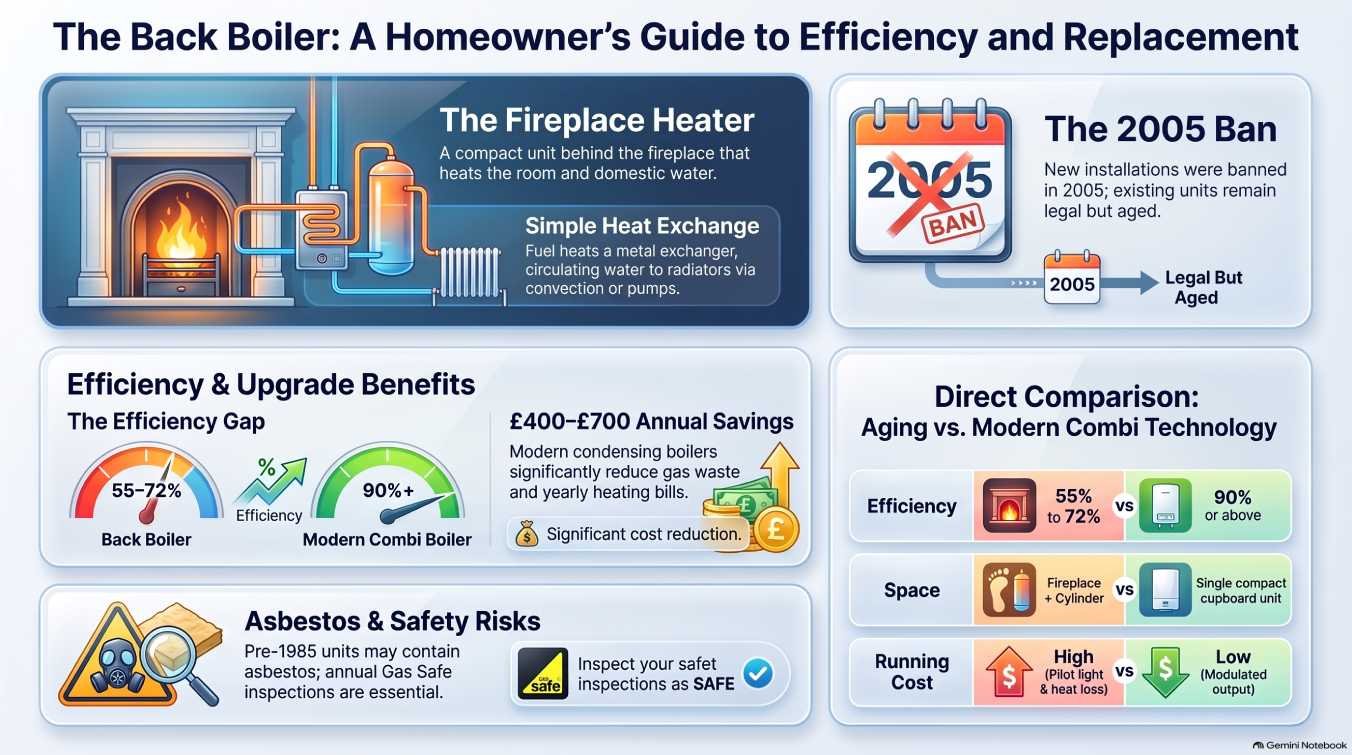
A back boiler works by heating water in a unit built into the chimney breast, directly behind your gas fire or fireplace. That hot water then heats your hot water cylinder, usually by gravity, and your radiators, usually with an electric pump, while the fire in front warms the room. New traditional (non-condensing) back boilers have been effectively ruled out since 2005, so if yours is a traditional one, it’s likely at least two decades old and running well below the efficiency of a modern boiler.
| Topic | Quick Answer |
|---|---|
| What it is | A heating unit built into a fireplace or gas fire, heating both the room and your water |
| How it works | A heat exchanger behind the fire warms water, which circulates to radiators and a storage cylinder |
| Still legal to use? | Yes, existing units can keep running. New traditional, non-condensing units have been effectively ruled out since 2005 |
| Homes still using one | A significant number, mostly in 1960s-80s terraced and council-built housing |
| Efficiency | Traditional non-condensing units: under 80% at best and often below 70%, against 90%+ for a modern A-rated boiler |
| Lifespan | Most were built to last 20 to 30 years and many keep running well beyond that, which says more about how simple they are than how well they perform |
| Asbestos risk | Units fitted before 2000 may contain it in gaskets or seals |
| Replacement cost | From £2,950 with BeFix (+VAT), final figure confirmed on-site |
What Is a Back Boiler?
A back boiler is a compact heating unit tucked into the chimney breast, directly behind a gas fire or, in older properties, a solid fuel fireplace. Rather than standing alone in a kitchen or cupboard like a modern boiler, it’s built into the fireplace itself and uses the existing chimney to vent exhaust gases. It’s also known as a back boiler unit, or BBU. Baxi and Glow-worm were among the best-known makers. The Baxi Bermuda, launched in 1966, is the most recognisable model by far, and plenty of these units are still working today, just not particularly well.
How Does a Back Boiler Work?
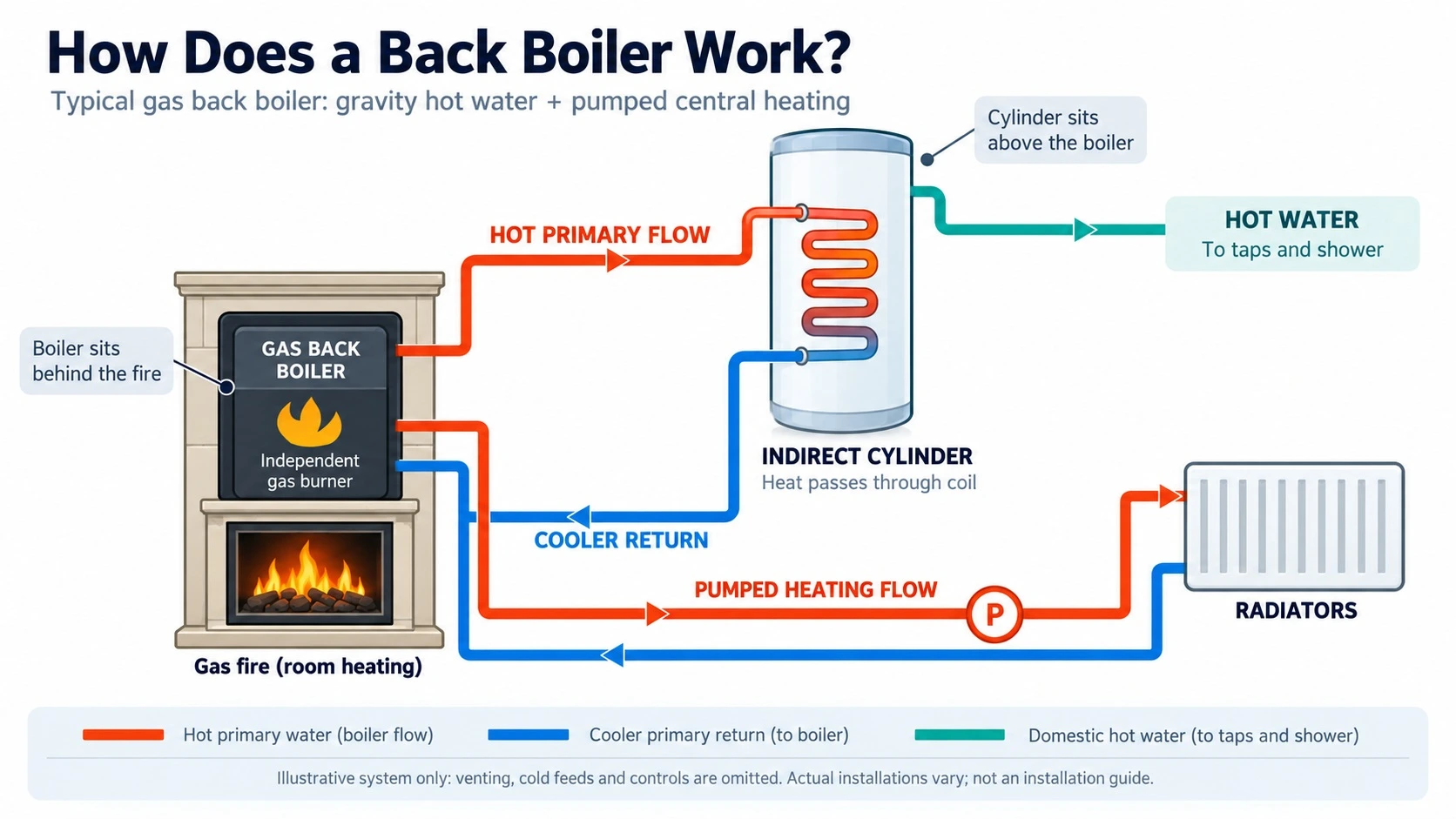
The mechanics are simple, which is part of why so many have lasted this long. A metal water jacket, often cast iron, sits in the opening just behind the fire front. On a gas unit such as the Baxi Bermuda, the boiler has its own gas burner and controls that heat this jacket, while the gas fire in front is a separate appliance that warms the room. On a solid fuel unit, one coal or wood fire does both jobs. Either way, the water picks up heat from the burning fuel and the hot flue gases passing over the jacket. In the most common arrangement, the heated water rises by convection to a hot water cylinder that sits higher than the boiler, while an electric pump sends water round the radiators. Waste gases leave through the chimney, via a flue arrangement designed for the appliance.
The Complete Water Circuit
On a typical set-up it’s two separate circuits sharing the same boiler: one runs to the cylinder, the other to the radiators. Older or altered systems can be plumbed differently, so an engineer should confirm yours.
- The gas burner (or the solid fuel fire) heats the water held in the boiler’s water jacket behind the fire
- That hot water rises by convection through a pipe to a coil inside the hot water cylinder, which has to sit higher than the boiler for this to work
- Inside the cylinder, the coil passes its heat to the stored water that supplies your taps and shower, so on a typical indirect cylinder the boiler water and your tap water never mix (some older installs use a direct cylinder, so ask an engineer to confirm yours)
- The cooler boiler water sinks back down to the jacket to be reheated, and the loop repeats without needing a pump
- A separate circuit, driven by an electric central heating pump on most systems, sends boiler water out to your radiators, topped up and vented by a small feed and expansion tank in the loft
- That open vent is a safety feature in its own right: it keeps the system open to the atmosphere instead of sealed, so on a typical gravity-fed system, if the pump fails or the power cuts out, the loop to the cylinder can still carry some heat away from the boiler, although how well this works depends on the design and condition of your system
What Does a Back Boiler Look Like?
From the room, you usually can’t see the boiler at all. What you see is a gas fire or fire front set into the chimney breast, with the boiler hidden in the opening behind it. Behind the fire front sits a metal unit with water pipes and a flue running up the chimney, but only a Gas Safe registered engineer should take the fire front off to look. A back boiler is the likely answer if you have a fire like this and no separate boiler anywhere else in the house. Other clues are a hot water cylinder in the airing cupboard, one or two water tanks in the loft, and a name plate from a maker such as Baxi or Glow-worm. If you still can’t tell, an engineer can confirm it in a few minutes during a survey.
Types of Back Boiler
Not every back boiler is the same, and the type behind your fireplace affects how it runs and what’s involved in dealing with it.
Gas Fire Back Boiler
The version most UK homes have. A conventional gas fire sits at the front, with the boiler unit built in behind it. On models such as the Baxi Bermuda, the boiler has its own burner and controls, separate from the fire. These are what were effectively ruled out for new installation in 2005, and they’re the ones this guide mostly covers.
Solid Fuel or Coal Back Boiler
Older still, and found mainly in period properties that never switched to gas. A coal or wood fire heats the exchanger instead of a gas flame, and the system normally has to be open vented rather than sealed, unless the appliance and system are specifically designed and protected for sealed use, because a blocked or boiling unit can build up dangerous steam pressure. The danger usually comes from a unit that has been left in place after a heating upgrade. If a solid fuel back boiler was decommissioned when the house switched to gas or oil but never actually removed, and someone lights a fire in front of it without knowing it’s still sealed behind the panelling, that pressure has nowhere to go. The Health and Safety Executive (hse.gov.uk) issued a safety alert on exactly this problem in 2008. It cited 2002 tests which found that the top and sides of an unvented solid fuel back boiler with no water circulating through it can pass 700°C, and HETAS, the body that approves solid fuel appliances, advises that if the fireplace is going to be used again, the only reliably safe route is to remove the back boiler completely along with its pipework. If you’re not sure whether an old fireplace has a redundant back boiler behind it, the HSE advice to homeowners is that you
should not light a fire in the fireplace until you have sought professional advice.
Back Boiler vs Modern Combi Boiler
| Factor | Traditional Back Boiler | Modern Combi Boiler |
|---|---|---|
| Efficiency | Under 80% at best, often below 70% | 90% or above |
| Hot water supply | Limited to what’s stored in the cylinder | On demand, limited by the boiler’s flow rate and output |
| Space needed | Fireplace cavity, plus a cylinder and often a loft tank | One compact unit, usually in a kitchen cupboard |
| Smart controls | Basic or none | Compatible with smart thermostats and zoning |
| Spare parts | Increasingly hard to source | Widely available |
| Can you buy one new? | No. Traditional units were effectively ruled out in 2005, and condensing replacements such as the Baxi Bermuda BBU HE are no longer made | Yes |
| Typical lifespan | 20 to 30 years, often longer | 10 to 15 years |
| Running costs | Higher, standing losses plus often a constant pilot light | Lower, modulates output to what’s actually needed |
| Impact on your EPC rating | Drags it down | Can meaningfully improve it |
| Servicing | Annual service essential, fewer engineers still cover them | Straightforward annual service by a Gas Safe engineer qualified for that appliance type |
Why Were Back Boilers So Popular, and How Many Are Left?
They were everywhere by the late 1970s, fitted as standard in new-build and refurbished homes across the country, and for good reason at the time. Terraced houses and smaller semis didn’t have room to spare for a separate boiler, so building the unit into an unused chimney cavity made sense. Installation was reasonably priced for the time too, since it used chimney infrastructure that was already there, which made it a natural upgrade for the many homes converting from solid fuel fires to gas in that period. You got a visible, cosy fire in the living room and whole-house heating from a single installation. Early models from Baxi and Glow-worm also earned a reputation for just running and running with barely any attention, which is exactly why so many are still going strong decades later.
A meaningful share of UK homes still rely on a back boiler heating system to keep the place warm. There’s no single reliable, up to date national count, but they’re concentrated in the same kinds of properties that had them fitted originally: terraced housing across Northern England, 1970s council-built estates, and Victorian or Edwardian homes converted to gas decades ago. Replacement costs running into thousands of pounds are the main reason so many are still in place. Some homeowners are also put off by the disruption, especially if new radiators or pipework are needed, which can turn the job into a wider central heating installation London project, and plenty simply don’t realise how much a modern condensing boiler would actually save them each year. On top of all that, a working back boiler still heats the house, just expensively.
Are Back Boilers Still Efficient?
No, and that is the main case for replacing one. Baxi says an old standard-efficiency back boiler is less than 70% efficient, and even the later Baxi Bermuda models are rated at roughly 72% to 77% seasonal efficiency in the maker’s own installation manual, against 90% or above for a modern A-rated combi or system boiler. That gap shows up directly on your gas bill.
Here’s how the published figures compare. Each of these back boilers carries a SEDBUK seasonal efficiency declaration in Baxi’s own installation literature. The table is a selection of Baxi models, not every back boiler ever made:
| Model | Type | Declared seasonal efficiency (SEDBUK) |
|---|---|---|
| Baxi Bermuda 57/4 M | Traditional, manual controls | 71.8% |
| Baxi Bermuda Inset 2 50/4 | Traditional | 72% |
| Baxi Bermuda 45/4 M | Traditional, manual controls | 72.7% |
| Baxi Bermuda 57/4 E | Traditional, electronic controls | 75.8% |
| Baxi Bermuda 45/4 E | Traditional, electronic controls | 76.8% |
| Baxi Bermuda BBU 15 HE | Condensing, room-sealed (no longer made) | 90.1% |
Two things stand out. Even within one range, the versions with electronic controls score around three to four points higher than the manual-control ones. And the highest-rated traditional model in this table still sits well short of the 92% ErP minimum that any new gas boiler fitted in an existing English home has had to meet since 2018. SEDBUK and ErP aren’t measured in exactly the same way, so treat the gap as a guide rather than a precise figure.
Why They Cost More to Run
Many older units have a permanent pilot light that burns gas around the clock whether you need heat or not. Older heat exchangers also lose a lot of heat up the flue. And a hot water cylinder, even a well-lagged one, loses heat sitting there waiting to be used. Put together, Baxi says that on an old standard-efficiency unit roughly 30p of every £1 of gas is lost up the chimney, and switching to a modern condensing boiler can cut fuel bills by up to £305 a year, according to an Energy Saving Trust estimate Baxi quotes. Treat that as an illustration rather than a guaranteed saving at today’s prices: the real figure depends on energy prices, how much heat your home uses and the system you have now.
What the Efficiency Gap Means in Pounds
To put a current figure on it, take Ofgem’s typical household gas use of 9,500 kWh a year and the average price cap gas rate of 7.97p per kWh for October to December 2026 (Direct Debit; source: ofgem.gov.uk). If that gas currently goes through a back boiler working at 72%, a 92% boiler would need about 2,065 kWh less each year to deliver the same heat, a saving of roughly £165. Starting from the highest-rated traditional model in the table, at 76.8%, the saving is nearer £125. The example assumes all of that gas goes through the boiler for heating and hot water, holds this quarter’s rate for a full year, and compares SEDBUK and ErP figures that aren’t measured in exactly the same way. Homes that still have a back boiler are often older and leakier than average and use more gas than the typical figure, and an ageing unit may no longer reach its original rating, so the real saving can be higher. Treat these as illustrations, not a quote: your own usage, tariff and the condition of your current boiler decide the actual number.
Advantages and Disadvantages of Back Boilers
| Advantages | Disadvantages |
|---|---|
| Visible fire as a room feature | Efficiency well below modern boilers |
| Frees up cupboard or kitchen space | Hot water runs out once the cylinder is empty |
| Proven longevity, often 20 to 30 years or more | Spare parts increasingly hard to find |
| Simple mechanical design, little to go wrong electronically | Basic controls, with limited smart or zoning options |
| Familiar to older, experienced engineers | Rising running costs as energy prices climb |
Is a Back Boiler Safe?
A back boiler that’s serviced every year, hasn’t been altered and has been checked by a Gas Safe registered engineer is generally safe to keep using. The concerns build up with age and neglect, not from the basic design.
Back Boiler Regulations
Are back boilers still legal? Yes, an existing one is fine to keep running. What changed is new installations. In April 2005, Part L of the Building Regulations (England and Wales) made condensing boilers the standard for new and replacement installations, and a traditional back boiler cannot condense, so fitting a new one was effectively ruled out. Boiler Plus later raised the bar in England: since April 2018, any gas boiler fitted into an existing heating system must reach at least 92% ErP efficiency. In practice, a back boiler is replaced with a different type of boiler rather than with another back boiler.
Asbestos Risks
Units installed before 2000 can contain asbestos in the gaskets, seals or internal insulation, which was standard heat-resistant material at the time, and the risk is highest in units fitted before the mid-1980s. If you’re planning any work on an older back boiler, from a service to a full removal, get it assessed by a professional first. Don’t attempt to disturb the casing or seals yourself.
Carbon Monoxide Safety
Most back boilers are open-flued, meaning they draw combustion air from the room rather than outside, which raises the stakes if seals or ventilation deteriorate with age. Annual servicing by a Gas Safe registered engineer, plus a working carbon monoxide detector in the room, are the two things that keep the risk low. Between services, keep an eye out yourself: soot or staining around the fire, a pilot light that keeps going out, or a burner flame that has turned yellow or orange instead of its usual blue are all worth getting checked. Many gas fire fronts are fuel-effect fires designed to burn yellow, so judge the fire by any change from how it normally looks. Never block the ventilation grille around the fire either, it’s there for a reason.
How Long Do Back Boilers Last?
Longer than almost anything else in your heating system, which is part of the problem. Most were built to last 20 to 30 years, and well-maintained units often keep going beyond that, thanks to having so few moving or electronic parts to fail. It doesn’t mean the unit is still doing its job well, just that it hasn’t broken. An annual service (combustion check, heat exchanger inspection, flue check, carbon monoxide test) starts from £80 and is worth every penny for as long as you keep the unit running.
Can You Replace a Back Boiler With a Combi Boiler?
For most homes, yes, and it’s the most common upgrade path. A combi heats water on demand, so the cylinder in your airing cupboard and, if you have one, the cold water tank in the loft can both come out, freeing up space as well as cutting your bills. The right size depends on the house, so it helps to know how to calculate boiler size before you compare quotes.
Combi Boiler
The default choice for smaller to medium homes with one bathroom. No cylinder, no loft tank, and hot water whenever you turn on a tap. BeFix carries out boiler installation London every week, so a back boiler to combi swap is familiar territory. If you have two bathrooms or want a stored supply of hot water, a storage combi boiler keeps a small tank, typically 40 to 100 litres, inside the unit, so you still don’t need a separate cylinder.
System Boiler
Keeps a hot water cylinder but drops the cold water tank. Better suited to larger homes or anywhere two bathrooms might need hot water at the same time. It’s often paired with an unvented cylinder, and BeFix’s Megaflo installation London engineers fit these as a routine part of system boiler swaps.
Wood-Burning Boiler Stove
A genuine alternative if you like the idea of a real fire but want to move away from gas. Unlike a standard wood burner, which just radiates heat into the room, a boiler stove has a water jacket built around the firebox, splitting its output between the room and your heating circuit. Wood is a renewable fuel, though how clean a stove actually runs depends on the appliance, the fuel and how it’s used. It also asks a lot in return: you’ll need a steady supply of dry, covered log storage, and installation is more involved than a standard stove fit because it has to be integrated with your radiator circuit. Fewer engineers take these jobs on because they’re relatively rare. Most households also still need an immersion heater or secondary boiler for hot water in summer, when nobody wants the stove lit just to run a shower.
Conventional Boiler
Keeps both the cylinder and the cold water tank. It’s the least common choice for a back boiler swap today, but occasionally the right fit for a larger property with low mains pressure.
What Does Replacing a Back Boiler Cost?
| Job | Price | Time on Site |
|---|---|---|
| Back boiler to combi swap | From £2,950 (+VAT) | 2 to 3 days, longer if asbestos removal is needed |
| Annual service or safety inspection | From £80 | Under a day |
£2,950 is BeFix’s starting price, exclusive of VAT. It covers removing the old unit, taking out the gas fire front, disconnecting the cylinder and any loft tank, fitting the new boiler, and certifying the work. Where asbestos removal, awkward access, or extra pipework pushes the job beyond a straightforward swap, that gets reflected in the final figure, which a BeFix engineer confirms once they’ve seen the job in person. If your household receives certain benefits, it’s also worth checking your eligibility for support through the government’s ECO4 scheme (details on ofgem.gov.uk) before booking any work. ECO4 closes on 31 December 2026, so don’t leave it late; after that, check what support has replaced it. Whether you qualify depends on your benefits, your home’s EPC rating and your tenure. Private rented homes, for example, need an EPC rating of E, F or G and the landlord’s permission, and ECO4 generally can’t pay to repair or replace a boiler in a private rented home. For eligible owner-occupiers, boiler replacement is covered in some cases, but not every household qualifies, and support is subject to eligibility and funding availability, so check before you commit to a date.
Repair or Replace My Boiler? Free Calculator
Tell us your boiler’s type, age and fault. You get a clear verdict (repair, replace or a close call), the reasons behind it, typical repair and replacement costs, and two common rules of thumb.
Smell gas? Do not use electrical switches or reset the boiler. Open windows if it is safe, turn off the gas at the meter if you can, leave the property and call the National Gas Emergency Service on 0800 111 999.
Carbon monoxide alarm or feeling unwell? Get everyone into fresh air, do not go back in, and call the National Gas Emergency Service on 0800 111 999. If anyone has symptoms such as dizziness, headache, nausea or has collapsed, call 999. Never open the boiler casing.
1. What type of boiler do you have?
2. How old is it?
3. What is wrong with it?
A few more details sharpen the result (typical answers are already selected, apart from the safety question)
4. Breakdowns in the last 2 years
5. Servicing history
6. Can the parts be found?
7. Running costs and performance
8. How long will you stay in the property?
9. Any safety warning?
Please choose your boiler type, its age and what is wrong, and answer the safety question, then try again.
The calculator needs JavaScript. The guides and price tables below work without it, or call BeFix on 020 8058 4241.
Safety first. If an engineer has marked your boiler At Risk or Immediately Dangerous, or you have seen soot, scorch marks or a carbon monoxide alarm, do not use it. A Gas Safe engineer must inspect it and make it safe before it is switched on again. Only once it has been assessed can you know whether a repair or a replacement makes more sense.
Reasons to repair
Nothing in your answers points this way.
Reasons to replace
Nothing in your answers points this way.
What it is likely to cost
Sensible next steps
Gas Safe registered (No. 967796) · Open 7 days a week · Free survey and written quote for replacements
This calculator gives general guidance from the answers you enter. The replace score is a simple weighting of your answers, not a probability of failure, and the two rules of thumb are rough guides, not industry standards. Costs are indicative, and only an engineer who has seen the boiler can confirm the cause and the price. Brand names are not used and BeFix is not affiliated with any manufacturer.
How to decide whether to repair or replace a boiler
There is no single age at which a boiler has to go. Most modern boilers last 10 to 15 years and well-serviced ones often last longer. What matters is how old yours is, what the fault will cost, how often it breaks down and whether parts are still available. The calculator above weighs these in the order an engineer would.
- Age. The older the boiler, the less sense it makes to put money into big repairs.
- Cost of the repair against a new boiler. A cheap fix on a working boiler is almost always worth doing. A repair that costs around half of a new boiler rarely is.
- Breakdown history. Two or three faults in two years usually means other parts are close behind.
- Parts. If parts are hard to get, repairs get slower and dearer.
- Running costs. Older non-condensing boilers waste more fuel than a modern condensing boiler, which is typically around 90% efficient or better.
- Safety. A boiler marked At Risk or Immediately Dangerous should not be used until a Gas Safe engineer has made it safe.
Repair or replace by boiler age
| Boiler age | What it usually means | Usual advice |
|---|---|---|
| Under 5 years | Well within normal life. It may still be under manufacturer warranty, which many brands offer for 5 to 10 years if the boiler was registered and serviced. | Repair. Check the warranty first. |
| 5–9 years | Reliable if serviced. Parts are easy to get. | Repair in nearly all cases. |
| 10–14 years | Mid to late life. Wear starts to show. | Repair small and mid-size faults. Weigh up a major fault. |
| 15–19 years | Past the typical life of a modern boiler. Efficiency and parts support are falling. | Repair small faults. Get a replacement quote for anything bigger. |
| 20+ years | Likely to be less efficient and harder to repair. | Replacement usually makes more sense. |
| Back boiler (any age) | Old design, spare parts increasingly scarce. | Replacement is often the better route. |
Two rules of thumb
The age × repair cost rule. Multiply the boiler’s age in years by the repair cost. If the answer is above about £5,000, replacing is often the better buy. It’s a rough rule of thumb, not an industry standard, and the engineer’s diagnosis and the real repair price matter more. A 12-year-old boiler needing a £350 part gives £4,200, so this rule leans towards repair. A 17-year-old boiler needing the same part gives £5,950, so it leans towards replacement.
The 50% rule. If a repair costs more than about half the price of a new boiler, replacing is usually better value, because you would be putting half a new boiler’s money into an old one.
Boiler repair cost vs new boiler cost
| Job | Starting price | Notes |
|---|---|---|
| Small fault | from £95 | Thermostat, sensor, pressure or ignition part. The starting price is one hour’s labour (£95 + VAT); the part is charged on top. |
| Mid-size part | from £200 | Pump, diverter valve, fan or circuit board. |
| Major failure | from £500 | Heat exchanger or several parts. Often close to the 50% line. |
| New combi boiler | from £1,500 + VAT | BeFix published starting price. |
| New system boiler | from £1,500 + VAT | BeFix published starting price. |
| New regular boiler | from £1,500 + VAT | BeFix published starting price. |
| Back boiler to combi | From £2,950 + VAT | Usually 2 to 3 days. |
Repair prices are indicative and depend on the boiler and the part. BeFix engineer labour starts from £95 + VAT per hour, with parts charged separately. Replacement prices come from a free survey and a written quote.
What to Expect When You Book a BeFix Back Boiler Replacement
The engineer starts by checking whether your unit is likely to contain asbestos based on its age, then assesses the fireplace, flue and existing pipework before recommending combi, system or another option based on your home and hot water needs. If asbestos is a possibility, it gets tested first, and where the material and risk level require it, removed by a suitably qualified or licensed specialist before any boiler work begins, never handled as an afterthought. Once that's clear, the swap itself, removing the old unit, fitting the new boiler, and making good the fireplace opening, normally takes two to three days for a standard job. You'll get Building Regulations certification once it's done.
Remove or Decommission a Back Boiler?
When the heating is replaced, the old unit can be decommissioned or removed. Decommissioning means a Gas Safe registered engineer disconnects the gas and isolates the water connections but leaves the unit in the chimney breast. Full removal takes out the unit and its pipework. If a solid fuel unit is left in place, HSE guidance is that it must be drained and left open to the atmosphere, never sealed. Draining alone doesn't make it safe, though: HSE warns there is likely to be residual water inside, which turns to steam if a fire is lit. If you want to use the fireplace again, HETAS advises removing the back boiler completely, and you should get professional advice before lighting any fire. Full removal is included in BeFix's starting price of £2,950 (+VAT) for a back boiler to combi swap.
Back Boilers and the Value of Your Living Room
Removing a back boiler means removing the gas fire in front of it too, which is usually seen as a downside but doesn't have to be. It's a chance to rethink that wall: a decorative electric fire, a wood burner, open shelving, or simply plastering over the opening for a cleaner look. Most homeowners treat it as part of a wider refresh rather than just a heating job. Expect a little cosmetic repair to the chimney breast once the old unit and fire front are out.
FAQs
Is it worth repairing a back boiler, or should I replace it?
If the repair quote is a sizeable share of what a replacement would cost, or the unit has needed repairs more than once recently, replacement usually makes more financial sense once you factor in the energy savings. Get a boiler repair in London quote first if you're not sure which side of that line you're on. For a unit already over 30 years old, even a smaller repair is often a sign to start planning a replacement instead.
Can I still get parts for an old Baxi or Glow-worm back boiler?
It depends on the model and age. Some basic parts are still available through specialist suppliers, but heat exchangers and control units for 1970s and 1980s models are often no longer made at all, and finding them gets harder every year.
Will removing my back boiler damage my fireplace?
The gas fire front comes out as part of the job, which does change how that wall looks, but a good installer keeps the damage to a minimum. Afterwards you can fit a decorative fire, add shelving, or close the opening completely, whatever suits the room.
Do back boilers work with underfloor heating?
It may be technically possible, but connecting underfloor heating to an older back boiler usually means extra controls, a mixing arrangement and other changes to the system. In most cases it makes more sense to have an engineer look at upgrading the boiler at the same time, so the new underfloor system runs on something designed for it.
How can I make my existing back boiler run a bit more efficiently?
Check your cylinder has a decent insulating jacket, lag the hot water pipes, fit thermostatic radiator valves, and keep up with annual servicing. None of this closes the gap with a modern boiler, but it can trim some of the waste.
Do landlords have to replace a back boiler?
No law forces a landlord to replace a working back boiler, but the appliance must pass a gas safety check by a Gas Safe registered engineer every 12 months, and tenants must receive a copy of the record within 28 days. BeFix arranges gas safety certificates London for landlords across the capital.
Does the gas fire need to be on for a back boiler to heat water?
On most gas units the boiler has its own burner and controls, separate from the fire, so you can usually heat water and radiators without the visible fire running. A solid fuel unit is different, because one fire does both jobs and the water only heats while it's burning.
Does a back boiler need electricity?
It depends on the appliance and how the heating system is connected. Many gas back boilers use electrical controls and a circulation pump, so a power cut can stop the central heating from working normally. Some older systems have a gravity-circulation hot water circuit that doesn't rely on a pump, but that doesn't necessarily mean the boiler itself can keep firing without electricity. Solid fuel back boilers are different, because a wood or coal fire can keep producing heat when the power fails, which is why proper circulation and venting matter so much on those. Never assume an old back boiler is safe to run during a power cut without checking the manufacturer's instructions and having the installation assessed by a competent heating engineer.
Are back boilers illegal?
No. If you already have one and it's safe, you can keep using it. What changed is new installations: since 2005 condensing boilers have been the standard for new and replacement boilers, so fitting a new traditional back boiler is effectively ruled out. Keep it serviced by a Gas Safe registered engineer, and get professional advice before anyone lights a fire in front of a redundant solid fuel unit.
Is there such a thing as a condensing back boiler?
A traditional back boiler can't condense, which is why new ones were effectively ruled out in 2005. Baxi did bring out a condensing model for the same fireplace opening, the Bermuda BBU HE, around 2009 to 2010. It was room-sealed, had a SEDBUK seasonal efficiency of 90.1% and was paired with an electric fire front, but it was a replacement unit rather than a traditional back boiler, and it has since been discontinued. An engineer can tell you whether a condensing replacement, or a combi or system boiler elsewhere in the house, suits your home.
Still Wondering About Your Back Boiler?
A back boiler that's been serviced, checked by a Gas Safe registered engineer and kept properly ventilated is generally safe, it's just expensive to run and getting harder to keep parts for. Most homeowners end up asking when to replace one. If you'd like a straight answer on your options, BeFix's Gas Safe registered engineers can assess your system and talk you through combi, system or wood-burning stove replacements. Call BeFix on 020 8058 4241 to book a visit.
Leave A Comment