

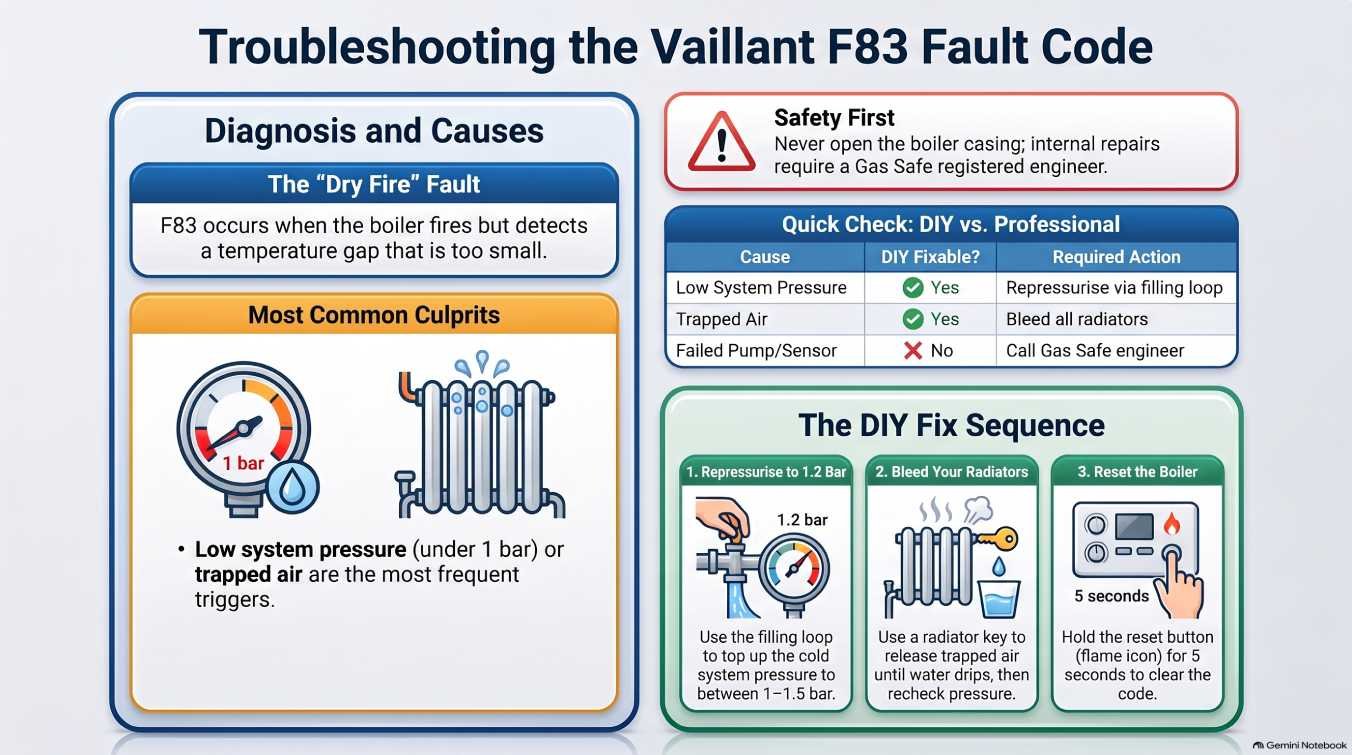
The Vaillant F83 fault code means the boiler has detected little or no temperature rise at the flow or return temperature sensor after the burner starts. Vaillant refers to this as a dry fire fault. Possible causes include not enough water in the system, poor circulation, or a flow or return sensor that is faulty or incorrectly positioned. F83 doesn’t say which part has failed, so the cause needs checking before any repair. Pressure and trapped air are safe to check yourself. Anything else needs a Gas Safe registered engineer.
| Question | Answer |
|---|---|
| Possible causes | Not enough water, poor circulation, or a faulty or badly positioned sensor |
| First thing to check | The pressure gauge, commonly around 1 to 1.5 bar when the system is cold |
| Can you fix it yourself? | Only the basic checks: pressure, bleeding radiators and one reset |
| When to call an engineer | If F83 returns after checking pressure, bleeding radiators and resetting once |
| Is it dangerous? | The lockout is the boiler shutting down safely |
What Does the Vaillant F83 Fault Code Mean?
The boiler watches the temperature of the water leaving it (the flow) and the water returning from your radiators (the return). Once the burner fires, those temperatures should start to climb. If the sensors register little or no rise, the boiler can’t confirm it’s heating water safely, so it shuts down and shows F83. Codes can vary between models, so check your manual if your display looks different.
F83 is a different fault from F23, even though both relate to water circulation. F23 means the temperature difference between flow and return has become too large, while F83 is about the boiler not seeing a temperature rise after the burner starts.
Common Causes of the Vaillant F83 Fault Code
| Cause | What It Can Look Like | Who Deals With It |
|---|---|---|
| Low pressure or not enough water | Gauge below normal, often after bleeding radiators or a small leak | You can top up as the manual describes. Engineer if it keeps dropping |
| Air in the system | Gurgling, radiators cold at the top | You can bleed radiators. Engineer if it keeps coming back |
| Poor circulation (failing pump, sludge, stuck or closed valve, bypass valve problem) | Some radiators cooler than others, a silent, humming or noisy pump | Engineer |
| Faulty or badly positioned flow or return sensor, or its wiring | F83 keeps returning and circulation seems normal | Engineer |
| Scale or debris in the heat exchanger (less common) | Poor heat transfer, usually on an older system | Engineer |
| Installation or controls wiring (zone valves, bypass valve, smart controls) | F83 started after new controls or work on the system | Engineer |
Low Pressure, Not Enough Water and Air
Insufficient water is one of the causes Vaillant lists. If the pressure is low, or air has collected in the pipes and radiators, water doesn’t circulate properly and the sensors may not register the expected rise. Air tends to get in after bleeding, repressurising, maintenance work or a small leak. These are also the easiest things to check.
Circulation Problems
A pump that has failed or is running slowly won’t move water round fast enough, and sludge or a stuck valve can have the same effect. Radiators that run cooler than the rest can be an early sign. On a combi the pump is inside the casing, so only an engineer can check it. If you’ve recently changed the pump speed, tell the engineer, and our central heating pump speed guide explains how the setting works.
Sensors, Heat Exchanger and Wiring
The flow and return sensors can develop faults and send false readings even when water is circulating normally. A sensor that isn’t seated properly in its pocket reads the same way, and so can loose or damaged wiring between the sensors and the control board. Scale or debris in the heat exchanger is a rarer cause. If your system has zone valves, a bypass valve or smart controls, F83 can also trace back to how they were installed or wired, so it’s worth telling the engineer when the fault started.
How to Fix a Vaillant F83 Fault: What You Can Check Yourself
Stay on the outside of the boiler and take these in order. If you’re unsure about any step, stop and call an engineer.
Step 1: Check and Top Up the Pressure
Look at the pressure gauge. With the system cold, it should sit where your manual says, commonly around 1 to 1.5 bar. If it’s below 1 bar, find the filling loop, a flexible hose with a valve at each end connecting the boiler to the cold water supply. Open the valves slowly until the gauge reaches about 1.2 bar, then close them fully.
Step 2: Bleed the Radiators
Turn the heating off and let the radiators cool. Using a radiator key, open the bleed valve at the top of each radiator slightly until you hear hissing, and close it as soon as water appears. Then check the pressure again, because bleeding lowers it, and top up if needed.
Step 3: Reset the Boiler Once
Follow the reset steps in your manual. If F83 comes straight back, stop there. Resetting only clears the message, and repeating it won’t fix a circulation or sensor fault.
Step 4: Listen for the Pump
With the heating on, you should hear a quiet hum from the boiler. Loud grinding or clicking, or no sound at all, suggests a pump problem. The pump is a sealed electrical part, so don’t touch it or try to repair it.
Step 5: Look for Leaks
Check around the radiators, pipe joints and under the boiler for water. A small leak that makes the pressure drop slowly can bring F83 back even after you top up. If you find one, turn the heating off and have it looked at.
Never open the boiler casing or touch internal parts. Diagnosing F83 beyond these checks is a job for a Gas Safe registered engineer.
When to Call a Gas Safe Engineer
- F83 returns after you’ve checked the pressure, bled the radiators and reset once
- You suspect the pump has failed
- The pressure keeps dropping
- Other fault codes appear alongside F83
- You’ve no heating or hot water and it’s cold
- Anything that means opening the casing
What an Engineer Will Check
An engineer will check the pump and circulation, test the flow and return sensors and their wiring, look for air, sludge and restricted valves, inspect the heat exchanger and review any controls or bypass valve fitted to the system. F83 only shows the symptom, so most of the job is finding the cause.
How Much Does It Cost to Fix a Vaillant F83 Fault?
The cost depends on what’s causing it. The pressure and bleeding checks above cost nothing. If an engineer is needed, BeFix charges £95 an hour from 7AM to 5PM, £125 from 5PM to 9PM and £160 from 9PM to 7AM, all exclusive of VAT, with no call-out fee. Parts are charged separately from labour, and your engineer will confirm the likely cost once they’ve diagnosed the fault. A sensor or wiring fix is a very different job from a heat exchanger repair.
Is the Vaillant F83 Fault Dangerous?
The fault itself is the boiler shutting down safely, so you’ll be without heating and hot water until it’s resolved. Fix the cause rather than resetting repeatedly. A leak behind a pressure loss can damage your home over time, and a failing pump left alone can leave you without heating in cold weather.
Other Vaillant Fault Codes You Might See
Vaillant codes beginning with F are faults that stop the boiler working, while codes beginning with S show status information. Your manual lists the full set for your model.
| Code | Meaning | Can You Fix It Yourself? | Full Guide |
|---|---|---|---|
| F22 | Low system pressure | Often, by topping up through the filling loop | Vaillant Boiler F22 Error Code |
| F23 | Temperature gap between flow and return too large, usually poor circulation | Partly. Bleeding radiators can help, but most causes need an engineer | Vaillant F23 Fault Code |
| F28 | Ignition failure at start-up | No, needs a Gas Safe engineer | Vaillant Boiler F28 Error Code |
| F62 | Gas valve closing late or flame detected when it shouldn’t be | No, needs a Gas Safe engineer | Vaillant F62 Fault Code |
| F75 | Pressure sensor or pump related fault | No, needs a Gas Safe engineer | No guide yet |
| F83 | Little or no temperature rise after the burner starts (dry fire) | Sometimes, depending on the cause | This guide |
How to Avoid F83 Coming Back
An annual service with a Gas Safe registered engineer can catch sensor drift, pump wear and scale before they cause a lockout, and many manufacturer guarantees require one, so check the terms of yours. Glance at the pressure gauge now and then to spot a slow leak, and bleed the radiators at the start of each heating season. Your engineer can also tell you whether the system needs cleaning or a magnetic filter to catch debris before it reaches the heat exchanger.
When to Consider a New Boiler Instead
If the boiler is old, F83 or other faults keep coming back despite repairs, and a repair quote is getting close to the cost of a new boiler, it’s worth asking your engineer whether replacing it would be better value. A modern condensing boiler is also more efficient than most older models. BeFix’s Gas Safe registered engineers can assess whether a repair still makes sense or advise on boiler installation in London.
Book a BeFix Engineer for a Vaillant F83 Fault
BeFix provides boiler fault diagnosis and boiler repair in London, including Vaillant F83 faults. Our Gas Safe registered engineers will find out why the boiler isn’t registering a temperature rise and fix it safely.
We offer same-day appointments, subject to availability, and engineers typically arrive within 1 to 3 hours. All repair work comes with a 12-month workmanship warranty. Photos of the display and the pressure gauge, plus the boiler model and serial number, help us prepare.
You can also book a boiler repair online, call 020 8058 4241 or email info@befix.co.uk with photos. We’re open Mon to Fri 7AM to 10PM and Sat and Sun 9AM to 8PM. BeFix is at 227B Nether Street, London N3 1NT.
FAQs
What does F83 mean on a Vaillant boiler?
F83 is a dry fire fault. The boiler has fired the burner but the flow or return sensor hasn’t registered enough of a temperature rise, so it shuts down. It doesn’t say which part is at fault, so the cause needs checking.
How do I fix the Vaillant F83 fault code?
Check the pressure and top it up through the filling loop if it’s low, bleed the radiators to clear air, then reset the boiler once following your manual. If F83 keeps returning, the cause could be the pump, a sensor, a blockage or the heat exchanger, and you’ll need a Gas Safe registered engineer.
Can low pressure cause the F83 fault?
Yes. If the pressure is too low, water doesn’t circulate properly, so the sensors may not register the rise the boiler expects. Topping up through the filling loop often clears it, but if the pressure keeps dropping there’s a leak to find.
How do I reset a Vaillant F83 fault code?
Follow the reset steps in your manual for your model, and only do it once. If F83 comes straight back, the cause is still there, so stop resetting and check the pressure and radiators or call an engineer.
Is it safe to keep using my boiler with an F83 fault?
The boiler won’t run while F83 is showing, because it has shut itself down as a safety measure. Don’t try to bypass or force it. Have the cause fixed.
Why does my F83 fault keep coming back?
A reset only clears the message. If F83 returns, something is still wrong. A slow leak, a failing pump, a sensor fault or scale in the heat exchanger could all be behind it, so the boiler needs a proper diagnosis.
What’s the difference between F83 and F23?
F83 means the sensors register little or no temperature rise after the burner starts, while F23 means the temperature difference between flow and return has become too large. Both involve circulation and sensors, so some of the checks overlap, but they are separate faults.
Can I fix the F83 fault myself?
You can check and top up the pressure, bleed radiators and reset the boiler once. The pump, sensors, heat exchanger and anything inside the casing are jobs for a Gas Safe registered engineer.
Leave A Comment